
Assembly of Nations
Soft Canon: Content still expanding
-
Soft Canon: Content still expanding -
The Assembly of Nations contains thousands of individual civilizations as a peacekeeping treaty organization. Originally started as a forum for governments to air grievances without the need to enter full scale conflict.
Now, the Council convenes the Assembly for large scale negotiations of technological standards and trade agreements utilizing the inherent neutral and incorruptible nature of the Administration that underpins the Assembly itself.
Even non-members of the Assembly and so call observers gain some benefits from it as a neutral ground to solve problems and settle their own disputes or as an intermediary during chaotic transitions in governments; however, only members can vote on and set international and internal policies of the Assembly itself.
This neutral mentality keeps the Assembly out of major incidents and has prevented skirmishes and quite common first-contact conflicts into full scale wars and minimize civilian casualties during such incidents.
To increase comradery and to give even the newest of members to the Assembly equal footing on the galactic stage, the creation of the Academy of the Assembly was introduced as a multinational war college to encourage interoperability as well as enforce the Council’s Laws of Armed Conflict to prevent indiscriminate violence by needlessly endangering civilians and disrupting critical infrastructure for survival.
All of this under the watchful eye of the Administrators and the Sheperd; a powerful and old semi-organic intelligence that predates most of known history. This oversite is constant, but renowned for impartiality creating a foundation based on fairness and stability.
Never hostile except in terms of defense, the Assembly has been actively recruiting members since CY354.
Most member nations have found benefits with such a strong community, but there has been some that are somewhat antagonistic to what the Assembly represents when it comes to individual sovereignty.
The Assembly
According to the Archivist, the Council of Nations was organized with official treaties ratified in CY318 (during the Second Epoch) with three civilizations officially becoming member nations and by CY320 after the eighth civilization participating in these assemblies did the Assembly itself became to be hosted by its members every Cycle as a show of good faith and equity among its members.
In CY817, the member nations, twenty-three at the time, established the Academy and set the Kor system, as it is already the home system of the Administrators, as the Campus.
Influence of Neutrality
With the Administration as a foundation, the Assembly of Nations maintains a strictly neutral position and open to other delegates, members or not, to use their forum to negotiate. Creating a dedicated safe space only expanded the influence of the Assembly as an institution to thousands of civilizations and species.
First Contact Committee
The powerful but neutral Administrators created the main backbone of the First Contact Fleet as well as several representatives from the Council. The First Contact Committee would watch fledgling civilizations as they are about to enter the galactic community and organize a, hopefully, peaceful first contact scenario. History is littered with First Contact Wars as simple cultural misunderstandings balloon into wide scale conflicts.
Leagues
Beyond the Council, the members have organized themselves into voting blocs known as Leagues. There are hundreds of different Leagues and each one internally debate common interests.
Vessels of Heraldry Compromise
As more and more members started to join the Assembly many new or perspective members grew concerned over the safety of their delegates, especially within the demilitarized Administrative Zones. After a Council meeting, the compromise of the Vessels of Heraldry was enacted that allowed a single warship from every member to be part of the diplomatic envoy. It wasn’t long after that, that these ships started to be examples of the might and culture of the individual civilizations they hail from.
The Administration
No one knows when the Administration was actually activated, it’s not recorded by the Archivist or at least not in the Archive Library. When the Archivist started to record in CY1, the Administration was already well established.
The Administrators
The curious species referred to as the Administrators are known as a manufactured organism as their entire biological makeup has been artificially created and then assembled, unlike engineered organisms that used a modified base organism or synthetic organisms as they have no ability to reproduce themselves without aid of a manufacturing facility.
Administrators are rarely seen outside of Administrative Zones, and after encountering one, many wish to keep it that way. they come in a variety of sizes that serve their function and move with unnerving precision. They are all interconnected in a hivemind controlled by the Shepherd.
The Shepherd
The Administration predates the eldest of the young species, sometime during the Second Epoch, nations rise and collapse, but the Shepherd was always there.
The Shepherd is a highly advanced and ancient synth that facilitates international relations. It goes by many different names and will physically manifest as whatever is culturally appropriate for the host, but its name always translates into something akin to Shepherd and would even refer to other Administrators as it’s flock.
The Archivist
The centralized intelligence that many interact with in some way when accessing the Archive Library. Its primary task is to collect, catalogue, and curate all the information that is gathered by the members of the Assembly as well as the individual Administrators.
Archive Library
The Archive Library is the collective database containing the sum of all knowledge from across the galaxy. Anyone has access to it, but due to its bulk, it is difficult to navigate without aid.
The Academy of the Assembly
The Academy was established shortly after the ratification of the Assembly in CY817.
The Academy of the Assembly is a high quality and tough four-year program that any member of the Assembly has access to. Students are screened through a selection process and are regularly culled every year through the program with a fifty percent failure rate. While not a nation of itself, it is considered the primary autonomous body of the Assembly itself and a resource that all members has access to in times of need.
The purpose of the Academy is to provide a mixture of common ground among Assembly members and to create a level field when it comes to training among the various militias that span the galaxy.
The Collaborative Security Council
Made from voluntary members of the Council, the Collaborative Security Council, while commonly confused with the Security League, concerns themselves with policies and mutual defense of the Assembly members from possible outside threats.
It was under the suggestion of the Collaborative Security Council that the Academy was established, as well as its general mission of humanitarian assistance and enabling interoperability between members.
Unified War Collage Academic Treaty
Not a glamorous name, but the Unified War-College Academic Treaty was signed and agreed to by all members of the Collaborative Security Council as an agreed upon standard for members of their militaries to become officers. Sponsorship and completion of the Academy generally allows for the graduate to gain a commission from their native military.
This allowed for high standards without individual civilizations needing to operate and staff their own programs.
Instructors
Most instructors are veterans among their nations and previous Academy graduates. They do the main instructions and command most of the Academic Expeditionary Corps during missions and have more expanded access to the Campus than most non-administrators.
Academic Expeditionary Corps
Starting with First Refinement students, they perform humanitarian and support operations as a form of field and practical training. The Academic Expeditionary Corps performs mostly peace time operations and small defense actions against rogue states or pirates when local defense forces can’t arrive in theater in time, but most of the time they are helping with evacuations and assisting in natural disasters while applying skills they have learned during the Crucible.
Administrative Vessels
When performing as the Academic Expeditionary Corps, they are using Administrative vessels and spacecraft as well as vehicles. These heavies can be modified on the fly to fit individual student training needs including mimicking the control layout to fit what the individual student would encounter when back in their native military.
Students
Outside of Administrators, the only denizens of the Academy are members of the Assembly, and most of them are either students or liaisons. Students enrolled at the Academy are treated equally, no matter the species, with their biological needs met.
Students are expected to study their respective crafts and skills. Completion, assuming the student doesn’t washback (start over that portion of the training), should take 5 decicycles (about 4 Terran years).
First Crucible
When the students first arrive to The Dorms (Kol D Prime) they are quickly sorted by biological compatibility needs (gravity level, atmospheric needs, dietary requirements) before sorted into their individual dormitory. From this point on, they will be assigned to their Training Corps with other students choosing similar academic tracks.
During this time, there is a lot of physical conditioning to maintain fitness, which helps avoid injury during more extensive training later, as well as, a lot of tests and evaluations. Essentially, during this portion of the Academy is more focused on ensuring that students are physically capable of completing the entire program.
Wash-backs, students who fail to complete but not severe enough to completely remove from the program, are common here as some students take time to acclimate to their new conditions.
Second Crucible
While maintaining their physical fitness requirements, the students are now evaluated for their knowledge retention and application. During this phase, they are learning common terms and definitions as well as general knowledge that will be needed to complete training. This includes the basics of international law and the Rules for Armed Conflict that has been established by the Assembly.
During this time, it isn’t uncommon for students to be washed-back as the rigorous study mixed with their need to maintain physical fitness can be stressful with a rate of nearly half. Decacycles ago, there was discussion about reducing the course load during this phase, but the largest opponents to this were the students themselves who viewed passing this phase to be a rite of passage.
First Refinement
Now that the academic and physical requirements are met during the crucible phases, the First Refinement begins the training in earnest with all students on equal footing. During this there is a mixture of class and field training with some students being picked early for the Academic Expeditionary Corps to gain increased knowledge and skills, especially when the Corps is low on students to fill a specific need.
During this phase, most students will get to leave The Dorms for the first time since beginning the program. Also during this time, the students native military would be doing regular check-ins to judge the progress of their candidate.
After all the evaluations, the students are divided into Cohorts based on their skills and weaknesses and are fluid as the student progresses, they may shift in which Cohort they belong to as their skills develop.
Second Refinement
By this time in the program, students are performing their field and practical duties and have already been assigned to units within the Academic Expeditionary Corps to apply those skills in real world situations. Those that have taken to the command tracks are given overseen command of other students during less hazardous operations.
However, at this point in the program, any failure is a total failure of the program and would require them to repeat the whole thing and not just the phase they failed.
The Forge
During this unofficial phase, the students are in constant contact with native sponsors to learn and integrate what they gained from their experience into their roles back with their militaries.
Lingual Standard
Standard is the common language that is shared among most civilizations of the Third Epoch. It is not super detailed and has many loan words from other languages as it spread across the starlight, however it is extremely effective for documentation and commerce between civilizations that may have no other common means of communication.
Spoken Word
The words within Standard has a direct translated meaning with no flourish that might be found in other languages, making it rather bland in comparison but easily understood and pronounced.
Code Program Language
Code is a standard sublanguage that deals with programing language of most technology. It is an adaptable language set that allows different language groups to write common programing that can be used in a variety of technologies.
Standard Pseudo-Syllabary
Standard uses a pair of phenom-glyphs that when combined make a full syllable.
The Glyph: Each phenom-glyph that makes half a sound of a syllable are very geometric with similar sounding phenoms looking similar.
Writing: The characters are written from left to right with the first sound of the syllable written above the second sound and if the syllable has a hard stop, it uses a taller version of the appropriate sound part. The whole words are surrounded with a block and while concepts or sentences are surrounded by a larger block.
Use
Standard is found in areas where multiple languages may be used and is normally used to convey important information such as the location of security or how to use a medical kit. Normally in personal communication, the individuals would communicate with a shared language that has more nuance.
Kol Campus Administrative Zone
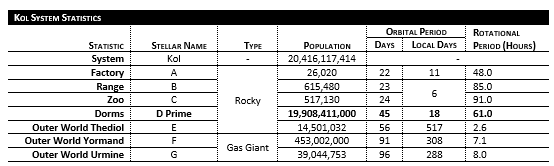
A system near the galactic core is commonly referred to as the Campus. This system is considered an Administrative Zone out to two lightyears from its central star (Kol). The system has seven worlds and hundreds of other bodies and is the central training area of the Academy of the Assembly as well as the primary hub for many Assembly and Administration activities.
As an Administrative Zone, the Kol system is completely under Administration purview and allows the use of Kol as a campus under their terms and terms of the agreement it made with the rest of the Assembly and the Collaborative Security Council.
The Factory (Kol A)
The innermost world is known as The Factory. Students and most faculty are not allowed onto this world. Only by Assembly resolution and Shepherd agreement has anyone ever surveyed Kol A.
The entire surface is a massive industrial complex dotted with massive replicators and other facilities. Everything the Academy needs is produced on this world, including any Administrators that are needed, predominantly Simulacra.
Tygora, Nasata, and Migarin (Kol A1, 2, and 3 respectively) are moons thought to be captured asteroids and serve as ports and defense positions for The Factory.
Fortress-World: Kol A is known as a fortress-world and is heavily defended by orbital drone defenses and surface-to-orbit weaponry. It is believed, beyond the prearranged visits, that the true nature of Kol A remains hidden from outsiders.
The Range (Kol B)
The Range is a mostly barren world and is used for weapon and heavy vehicle demonstrations and training. The entire surface is pockmarked with craters and weapon scars with entire content sized zones designated as impact areas for live fire and orbital bombardment practice.
Around Kol B is large ring made of debris and its own shattered moons along its equatorial plane. There are multiple low orbit targets that are used for orbital weapons training filling the sky with debris and an almost constant meteor shower as the debris enters the atmosphere along side multiple orbital habitats and docks for visiting starships.
Every decicycle there is a global dust storm lasting about two centicycles, the world experiences a massive global dust storm that resurfaces the planet and clears away the most superficial imperfections.
The Zoo (Kol C)
Hostile and deadly entities from all over the galaxy can be found in the ecologically diverse world of the Zoo. Kol C serves as a central location for a variety of survival exercises as zones are carefully maintained by the Administrators.
Talasa (Kol C1) has a massive underground cave complex filled with many space-borne and low gravity species.
Due to the unique environmental requirements and biology of most of the entities on world, a two week quarantine is needed before going planet-side and a week quarantine when leaving. This is to avoid spreading invasive species and pathogens.
The Dorms (Kol D Prime)
There are student facilities all over the system, but the Dorms on Kol D is dedicated to student and faculty housing and services. The actual facilities are sprawling across kilometers of any livable surface with aquatic facilities and different atmospheric zones to accommodate a large variety of species with Uniagou (Kol D1) dedicated to low gravity species.
One of the more prominent features of the Dorms is a massive space-elevator complex and massive orbital shipyard ringing around its equator housing hundreds of docked starships and thousands of spacecraft at any moment.
Most of the in-class work is done within the Dorms and seldom do any Crucible students leave this world during their studies.
Port-of-Call
The Dorms is the primary port-of-call for the Kol system. While most systems are welcoming to travelers, especially at their ports-of-call, Kol is a strong exception. Only authorized travelers are allowed to enter the system in general. Unauthorized vessels and travelers are immediately detained by the Administration with anything proving hostile being destroyed.
The Outers (Kor E F G)
The Outers are a set of gas giants with many moons. The Outers are used as additional training grounds and assembly areas.