Exploration
Exploration is a critical part of any mission or campaign. General exploration is how an entity moves and interacts with their environment.
Be it a world, or a derelict space station, the environment is the space the entity interacts with that isn’t necessarily an entity.
Table of Contents
Gravity
In space, down is towards the closest large mass. Near celestial bodies, that is easy to determine; however, gravity is not always equal wherever Freelancers find themselves.
Unless stated otherwise, local gravity is always Earth normal 1G or 9.8 m/s2. If that is the case, then all rules are followed as normal. However, if gravity is higher or lower, then effects can be slightly different.
Gravity Sickness
When gravity changes, it can cause a wave of nausea similar to motion sickness as the body attempts to adapt to the change. A Fortitude check will be needed if gravity changes by more than 2G in a single round (4/difference in gravity).
Failure would cause the entity to gain one stun counter as they are dealing with their nausea.
Passing Out and Death
When a living entity enters a gravity, they are not acclimated to, they run the risk of passing out due to a lack of blood flow to the brain as blood starts to pool in the lower extremities and the heart has a harder time pumping.
When entering a heavier gravity, they must succeed a Fortitude check to avoid becoming incapacitated. During upkeep, they may make another check to become conscious.
However, if the minimum Fortitude is twice the entity’s current Fortitude, they become incapacitated on the first fail, and then bloodied on the second. If they fail a check while bloodied, then their health drops to 0 and is dying.
Strength and Difficult Terrain
Because of the increase of gravity, the entity’s weight also increases, this requires a minimum strength score otherwise the entity treats all movement as though it was difficult terrain as it takes them more effort to move.
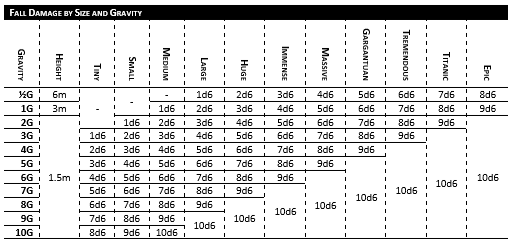
Falling
Where there is gravity, there is a risk of falling.
Depending on the size of the entity and the height they are falling from, they will take damage.
Vision and Hearing
Seeing and hearing are the two most used senses and are heavily relied on and are used to understand and navigate the environment.
Penalties
As an external penalty, this is applied to the Freelancer’s roll itself, making it more difficult to succeed an Awareness check.
Light Levels
The dimness or brightness of light can obscure vision. Noted in the light level, it will have an obscured rating and a note if it’s from darkness or brightness.
Brightvision and Darkvision
Some entities can see in various lighting conditions within a limited range. Brightvision allows the entity to see more clearly in very bright lighting conditions while darkvision allows them to see in lower lighting conditions.
An entity with brightvision or darkvision is unaffected by vision penalties due to bright light or darkness respectively out to their noted range.
Perfect-Vision reduces the obscure rating in either bright or dark conditions.
Blindsight
Entities that can functionally see without the use of eyes or similar organs have blindsight. Blindsight is noted as a range and beyond that range, they are functionally blind with that sense.
Truesight
Truesight is a unique ability among most entities. This ability is noted with a range.
This ability works for any effect with the illusion tag or on shapechanger making their true form known to the entity.
For example, an entity with truesight 6 meters means that they know that an entity is actually a hologram within that range without the need for checks.
Scanning and Signatures
There are many different technological sensors that are able to discern information about objects and entities from great distances; however, the quality of that information depends on the targe’s signature and its ultimate range.
Signature
Everything has a signature. This is the modification to the sensor range envelope and its effects.
A positive signature means the target can be detected at a greater range. A signature of +2 means the target can be seen from two envelopes further out. If it would normally be seen at medium range, it can be detected at far range and so on. That also means that any details that can only be discerned by the sensor at close range can be done at long range.
A negative signature means the target can only be detected at a closer range. A signature of -2 means the target can be seen from two envelopes closer in. if it would normally be seen at long range, it can be detected only at close and so on. That also means that any details that would normally be discerned at long range can only be discerned at close.
What is Detected
Depending on the sensor, mode, and envelope, a scan can determine a lot of information.
Mode
Sensors generally have two sensor modes, passive and active.
While a sensor is in active mode, it is emitting energy in a variety of intensities and frequencies and watching for the return and how that return is different to determine information. This is the standard operational function, but it also increases the signature of the scanner, sometimes by a lot.
Passive mode is only listening and not actively broadcasting a signal generating no additional signature beyond the power consumption of the component. While passive, the effective range envelope of the sensor is dramatically reduced, often to only close range.
Sensor Envelope
While what the sensor is detecting is listed on the sensor itself when in use, there are some general commonalities.
Close: The highest detail possible with the sensor.
Medium: What the target is.
Long: The type of target in general terms (beast, vehicle, rock, etcetera).
Far: The direction and range of a target.
Extreme: The presence and direction of a target but nothing really else.
Signature Factors and Thresholds
There are a variety of reasons for the signature of something to vary from materials absorbing or reflecting the scanner energy to its own energy output.
Size and Mass
The size of the target, object or entity, creates the baseline of the signature threshold. The Mass of a vehicle of spacecraft also generates a base signature factor. These factors do not include any possible equipment or components that can increase or decrease the signature factor.
Entity Movement
Entities move through their environment. While in combat, their speed is easy to discern, out of combat, the time scales are much larger, and entities can move much further.
Speed
Every entity has a base speed, most commonly its 9 meters every move-action. This movement is along the ground, however, there are additional movement modes.
Burrow
Burrowing is through the ground and loose dirt unless noted otherwise.
Climb
Climbing is movement across non-horizonal surfaces without the need for making checks until they stop their movement on a non-horizontal surface.
Perfect: If they have a perfect climbing, they do not need to make checks to remain on a non-horizontal surface at the end of their movement.
Fly
Flying allows for movement without being in contact with a surface. This movement has two values, the first value is their minimum movement and the second is their maximum movement. They must make their minimum movement by the end of their turn or they fall.
For example, an entity with a speed of Fly 3m/9m means that during their turn, they must move at least 3 meters or they fall from the sky.
Hover: If the entity has hover as part of their fly movement, they do not risk falling while flying around.
Sprint
While moving, regardless of mode, you expend any number of exertion die to move an additional 1.5 meters per die expended this way.
Swim
Swim speeds means the entity doesn’t need to make checks while swimming.
Special Movements
Many times, when exploring their environment, an entity will do more than just walk across a level field.
Climbing, Crawling, and Swimming
To climb, crawl, or swim, an entity takes up an extra 1.5 meters of movement.
Strength Check: Entities who are climbing or swimming need to roll a Strength or Fortitude check. If they fail, they fall or start to flounder in the water.
Jumping
The stronger an entity is the farther or higher they can jump. All measurements are from the bottom of the entity.
High Jump, Standing: An entity can jump up into the air 1.5 meters for every ten points in their Strength bonus. For example, if the entity has a 40 in Strength, they can jump up 1.5 meters. This movement uses 3 meters of movement.
Long: If the entity moves at least 3 meters before they jump, they will jump up 1.5 meters for every five points in their Strength. The height or length of the jump is divided as the entity sees fit for the jump. In this example, the entity with a 40 in Strength, they jump up 3 meters up to the entities total speed.
Landing on Difficult Terrain: If an entity is landing on difficult terrain, they must succeed a Strength check or become prone.
Travel
It is impractical to depict long range and duration travel at combat-scale.
While traveling in a group on foot, they usually take on the pace of the slower of the group. Below is a table to aid in figuring out how far a team can travel in an amount of time.
Fast: A team moving quickly will lose an exertion die for every hour of movement. However, they move 1.5 times faster pace.
Slow: A team moving slowly will move at half the pace, however, they can make stealth checks to go unnoticed.
Resting while Traveling
Freelancers must stop and make camp or otherwise shelter in order to gain the benefits of a full rest and a team moving at a fast pace cannot gain the benefits of a quick rest, assuming they are traveling on foot. If in a vehicle, they can rest like normal as long as they take turns piloting it.
Difficult Terrain
At both combat-scales and in travel-scale, difficult terrain will slow down movement.
Difficult Terrain: Difficult terrain requires 3 meters of movement for every 1.5 meters moved. At travel-scales, it halves the distance that can be moved.
Extreme Difficult Terrain: Extremely difficult terrain requires 4.5 meters of movement for every 1.5 meters moved. At travel-scales, it thirds the distance that can be moved.
Agility check
An Agility check must be rolled every 3 meters of actual movement or they fall prone in that space. The check is unfavorable if the terrain is extreme.
ConsuMABLES
Entities need food and water to survive. The amount varies per species and their individual needs, but they all fall on similar lines depending on size.
Food and Water
Unless stated otherwise, living entities need to eat food and drink water. Some need to eat more or less for the energy and nutrients they need to survive.
Carbon versus Silicon
Most living entities are carbon-based and have similar nutritional needs, or at least, similar enough to allow them to eat and take in sustenance from similar materials such as proteins, fats, and sugars. Silicon-based entities have a very different nutritional need as their diet is based on chains of silicon rather than carbon. Because of that, their diets are incompatible with each other and while not toxic to each other, eating the other’s food will provide no benefits.
Thirst and Starvation
If an entity doesn’t get enough food and water, they start to suffer from the ill effects of starvation.
After three days without food or two days without water, the entity will lose an exertion dice and it cannot be recovered until they eat.
Radiation
Entities can encounter radiation in a variety of ways. From being exposed to space to encountering an unshielded reactor.
Exposure
Radiation necrotizes flesh and can corrode or alter materials. When exposed to a certain radiation type, entities must succeed a Fortitude check. The type of radiation or the exposure itself will determine the check.
On a failed check, the target gets the radiation’s Rad value.
Rad
Radiation produces a Rad value. That value is the number of radiation counters the target gains.
Half-Life
After a full rest, the entity must succeed a Fortitude check or take 1d10 damage [necrotic] for each radiation counter they have; if they are immune to damage [necrotic], ignore this damage.
Failing this check expends two exertion die does not recover until the entity passes a check.
They then remove half the radiation counters, rounded up.
For example: a Rad 10 exposure means the target gains 10 radiation counters. After a full rest, the target takes 10d10 in damage [necrotic]. After the next full rest, they would take 5d10 damage [necrotic], then 2d10 necrotic, then 1d10 necrotic and then no more damage.
Repeated Exposure
If you get exposed to radiation repeatedly, even from the same source, the effects stack. So, a Rad 1 exposure is met with another Rad 1 exposure, they would have a Rad 2 at the end of their next full rest.
Contamination
Depending on the type of radiation exposure will determine if you are affected.
Assuming the radiation isn’t part of an attack, you can get affected by radiation in a variety of ways.
Contact: The entity must come into physical contact with or is damaged by the substance to be affected.
Exposure: They just need to be within a few meters of the material to be affected, this does not include ranged attack damage.
Internal: The material needs to be inside the body in some way to be affected.
Radiation Examples
This list of radiation is not exclusive and diverse types of radiation and radiation sources can be found in the galaxy, sometimes literally. The examples provided are common types.
Alpha
This is a common form of heavy atom decay that emits the equivalent to a helium nucleus at high speeds.
Antimatter
Anti-matter has all the same general properties of normal matter, except it has the opposite charge. When antimatter contacts normal matter, they annihilate into a burst of energy.
Antiproton
The mass of a normal proton but with a negative charge. An antiproton annihilates other protons it comes in contact with, destabilizing and at times, obliterating the atom.
Positron
A positron has the exceedingly light mass of a normal electron, but with a positive charge. When a positron encounters an electron, they annihilate in a small burst of radiation and the atom becomes ionized, seeking more electrons to fill the gap.
Beta
Beta decay is a type of subatomic decay that can come from a neutron to eject an electron to become a proton, changing the nuclear properties of the atom.
Cosmic Radiation
Cosmic radiation is a nondescript form of low-level radiation that is common throughout space itself.
Gamma
Gamma radiation forms from the decay of nuclei and can penetrate materials deeply though short lived.
Gamma Burst
Gamma bursts are caused when gamma radiation coalesced into a single focused blast.
Hawking
Hawking radiation forms on the edges of event-horizons when virtual particles spontaneously come into existence due to quantum effects and instead of annihilating and dissipating back into the void, one of the particles is taken away or otherwise, annihilation is prevented.
Neutron
Some nuclear processes when a heavy atom decay can produce neutrons. The heavy neutrons can damage or otherwise break up other heavy atoms and break molecular bonds.
Tachyon
This strange photon-like particle can cause damage to materials if exposed to it. The quirk of tachyons is that they cannot travel slower than light but have no upper limit. It is theorized that this is an illusion of perception, and a tachyon is just a photon traveling backwards through time as specially calibrated sensors detect tachyons moving away from the receiver, towards the emitter.
Theta
This radiation permeates irreal-space and other areas with extremely low Hume levels. It is caused by the breakdown of reality itself.